
Musty Smell in Basement? Find the Source in 15 Minutes
A musty smell in basement air almost always means something down there stays damp long enough for mold, mildew or bacteria to grow on it. Find the water and you find the smell. Sprays and scented products only cover it up.
This guide gives you a 15-minute check that narrows the source down to condensation, seepage, a plumbing leak or damp storage. Then it shows you how to dry the space, clean what is growing and keep the odor from coming back.
Quick answer: A musty basement smell comes from damp materials where mold or bacteria grow and release odorous gases. Measure the humidity first: the EPA advises keeping it below 60% (ideally 30–50%). Then look for condensation on cold walls and pipes, dampness at the base of the walls, plumbing leaks, and damp cardboard or carpet. Fix the water, run a dehumidifier, clean small moldy areas with detergent and water, and throw out soaked porous items.
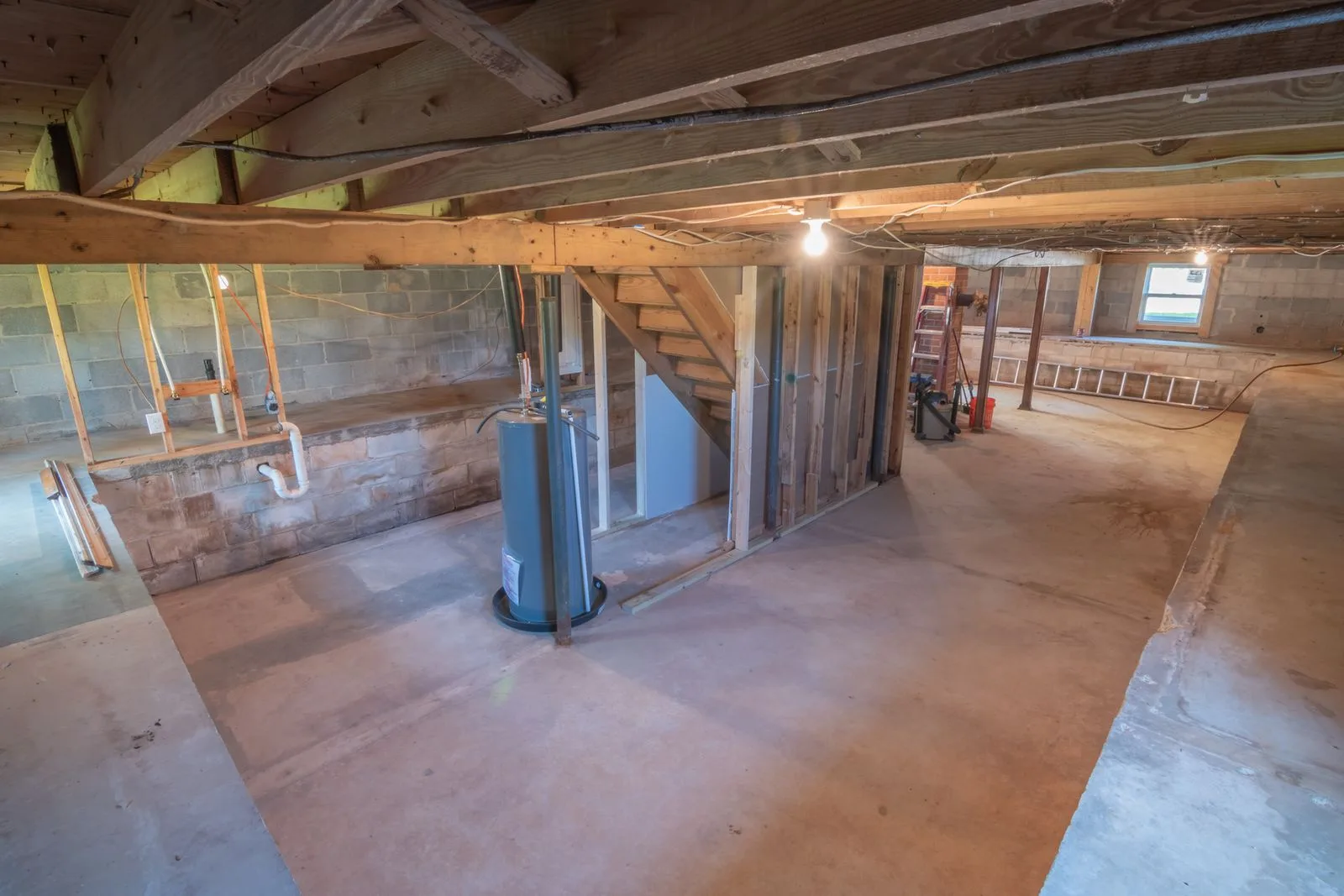
Musty smell in basement at a glance
Most basement odors trace back to one of six sources. Use this table to match what you notice with the quickest check and the fix.
| Likely source | What you notice | Quick check | Fix |
|---|---|---|---|
| Condensation | Worse in humid summer weather; beads of water on cold pipes or walls | Hygrometer reads above 60% | Dehumidifier; insulate cold pipes |
| Water coming through the walls or floor | Damp band or water marks at the base of the walls, worse after rain | Look and feel along the wall base after a storm | Clear gutters, extend downspouts, slope soil away; a pro if it persists |
| Plumbing leak | Smell strongest near one spot; wet floor under pipes or appliances | Check supply lines, drains, water heater and washer hoses | Repair the leak and dry within 24–48 hours |
| Damp stored items | Boxes, carpet or old furniture smell strongest up close | Lift items and smell the undersides | Dry them out or throw them away |
| Dry floor drain trap | Rotten-egg smell, not musty | Look into the floor drain | Pour water into the drain |
| HVAC or dehumidifier | Smell appears when the system runs | Check the bucket, drain line and drip pan for standing water | Clean and dry; stop using a system you suspect is moldy |
What causes a musty smell in a basement?
The smell is chemistry. Microorganisms growing on damp materials give off volatile organic compounds into the indoor air, and some of those compounds are what your nose reads as “musty.” The World Health Organization lists a perceived moldy odor as one of the indicators of dampness and microbial growth, next to condensation and visible mold.
One of the best-studied fungal odor compounds is 1-octen-3-ol, often called mushroom alcohol. Researchers describe its smell as mushroom-like, with a moldy, grassy note in one of its two mirror-image forms, and note that people detect it at very low concentrations. That is why your nose often finds a problem before your eyes do.
The EPA makes the same point from the practical side: a musty odor can mean mold is growing where you can’t see it, such as behind drywall, wallpaper or paneling. A finished basement with a smell and no visible mold still deserves a closer look.
Why basements smell more than the rest of the house
- Cool surfaces. Walls below ground stay cooler than the air. When humid air touches a surface colder than its dew point, water condenses on it.
- Water in the soil. Rain that drains toward the foundation keeps the walls and slab damp. ENERGY STAR’s first moisture tips for basements are about gutters, downspouts and grading.
- Food for mold. The CDC notes that mold can grow on wood, paper, cardboard, drywall, carpet and upholstery. Basements are where most of those end up in storage.
- Little air movement. Closed doors and few windows let humid air sit, so damp spots stay damp.
All four come back to the same trigger. The WHO guidelines name the amount of water on or in materials as the most important trigger for the growth of microorganisms indoors. Control the water and the smell has nothing to feed on.
How to find the source of a musty basement smell in 15 minutes
You need a hygrometer (an inexpensive humidity meter), a flashlight and your nose. Go down after the basement has been closed for a few hours, so the smell is at its strongest. Work through the steps in order.
- Minutes 0–2: start the humidity reading. Put the hygrometer in the middle of the room, away from the walls, and let it settle while you do the next steps. The EPA advises keeping indoor humidity below 60%, ideally between 30% and 50%.
- Minutes 2–5: map the smell. Walk the perimeter slowly. Stop at each corner, behind the stairs and next to stored items. Crouch down, because damp air and damp materials often sit near the floor. Note where the smell is strongest.
- Minutes 5–8: check the base of the walls. Shine the flashlight along the bottom of each foundation wall and the edge of the slab. Look for a dark damp band, water marks or peeling paint. Touch suspicious spots with the back of your hand.
- Minutes 8–10: check cold surfaces. Look at cold-water pipes, metal ducts and the coolest wall. Droplets on them point to condensation, which the EPA lists as a sign of high humidity.
- Minutes 10–12: check plumbing and appliances. Look under the water heater, the laundry tub, washer hoses, the sump pit and any exposed drain lines. A leak usually leaves a wet spot with the strongest smell right above it.
- Minutes 12–14: check soft materials. Tip cardboard boxes away from the wall, lift the corner of any carpet or rug, and smell the back of upholstered furniture. Damp porous items are a common source in basements used for storage.
- Minutes 14–15: check drains and equipment, then read the hygrometer. If the floor drain smells like rotten eggs, its trap may have dried out and let in sewer gas, which is a different problem from a musty smell. Check the dehumidifier bucket and any drip pan for standing water.
If the reading is above 60% and you found no leak, condensation is the most likely cause. If the reading is normal but one spot smells and feels damp, look for water getting in at that spot or a hidden leak.
Condensation or water coming through the wall?
A damp wall can be wet from either side, and the fixes are different. A simple overnight check follows from the physics: tape a square of aluminum foil or clear plastic tightly to the damp spot and look at it after a day or two.
- Water on the room side of the foil: humid room air is condensing on a cold surface. Lower the humidity.
- Water on the wall side, under the foil: moisture is coming through the wall from the soil. Look at drainage outside first.
- Both sides wet: you probably have both problems.
Worked example: is your basement wall sweating?
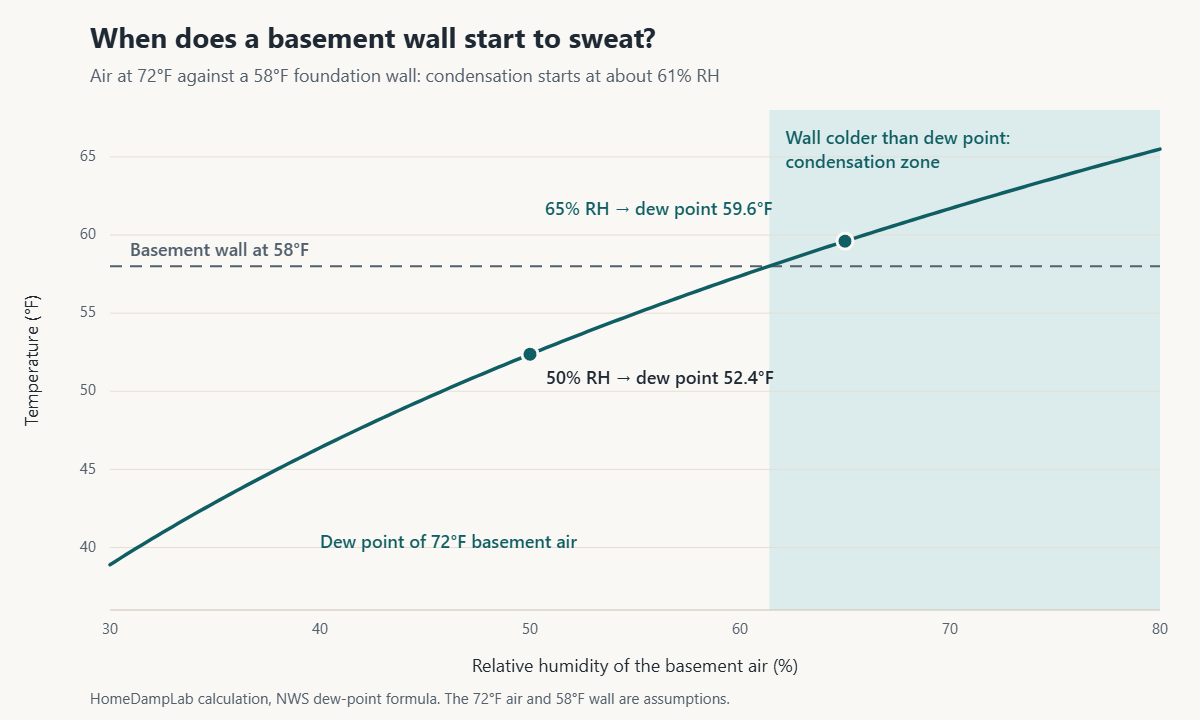
Condensation starts when a surface is colder than the dew point of the air around it. The National Weather Service defines the dew point as the temperature air must be cooled to, at constant pressure, to reach 100% relative humidity. Here is what that means for a basement with 72°F air and a foundation wall at 58°F.
| Basement humidity at 72°F | Dew point | Wall at 58°F |
|---|---|---|
| 45% | 49.5°F | Stays dry (8.5°F margin) |
| 50% | 52.4°F | Stays dry (5.6°F margin) |
| 55% | 55.0°F | Stays dry, but only 3°F of margin |
| 60% | 57.4°F | Borderline: 0.6°F of margin |
| 65% | 59.6°F | Condensation likely |
| 70% | 61.7°F | Condensation likely |
The jump from “dry” to “wet” happens over just a few percentage points. At 65% humidity the dew point is about 60°F, so a 58°F wall collects water. Bring the same air down to 50% and the dew point falls to about 52°F, leaving the wall more than 5°F above it.
This is why the EPA’s 30–50% range works well in basements. It keeps a margin between the dew point and the coolest surfaces, so they stay dry and the musty smell has nothing to grow on.
How to get rid of musty smell in basement air (in the right order)
The order matters. If you deodorize before you dry the space, the smell comes back as soon as the product wears off. Work from the cause to the symptom.
1. Stop the water
Repair plumbing leaks first. Outside, ENERGY STAR recommends extending downspouts away from the foundation, keeping gutters clear, sloping soil away from the house and not overwatering plants next to the foundation. It also suggests repairing leaking outdoor faucets. These steps can lower basement humidity before you spend anything on equipment.
2. Dry the air
Run a dehumidifier and set its humidistat. The EPA target is below 60%, ideally 30–50%, and the CDC recommends keeping humidity no higher than 50%. If your unit has no humidity display, use a separate hygrometer. Keep basement doors and windows closed while it runs, as ENERGY STAR advises.
Cool basements have one catch: ENERGY STAR notes that frost can form on the coils below about 65°F. If you see ice on your unit, turn it off and let it thaw.
3. Dry or remove wet materials
The EPA says wet or damp materials should be dried within 24–48 hours of a leak or spill, and that in most cases mold will not grow if you manage that. Move boxes off the floor and away from walls. Swap cardboard for plastic bins with lids.
4. Clean small moldy areas
For an area under about 10 square feet, roughly a 3 ft by 3 ft patch, the EPA says you can usually do the cleanup yourself. Scrub hard surfaces with detergent and water, then dry them completely. Porous materials such as carpet and ceiling tiles may need to be thrown away, because mold can grow into them and be impossible to remove fully.
5. Clear the last of the odor
Once the source is gone, air the basement out and let the dehumidifier run. The EPA treats a lingering moldy odor as a sign that cleanup is not finished, so if the smell stays after a week of dry readings, go back to the 15-minute check and look behind finished walls and stored items.
Safety first. Never mix chlorine bleach with ammonia or other cleaning products, because toxic fumes can form. Keep the area ventilated. For mold cleanup the EPA recommends an N95 respirator that fits properly, long gloves and goggles without ventilation holes.
Dehumidifier for basement smell: what capacity do you need?
Dehumidifiers are rated in pints of water removed per 24 hours. ENERGY STAR sizes them by how damp the space is before you start and by its size. A basement that smells musty is usually in the first or second row.
| Condition without a dehumidifier | Under 2,000 sq ft | Over 2,000 sq ft |
|---|---|---|
| Slightly to moderately damp (50–75% RH) | 20–30 pints/day | 30+ pints/day |
| Very damp (75–90% RH) | 25–40 pints/day | 40+ pints/day |
| Wet (90–100% RH) | 30–50 pints/day | 50+ pints/day |
ENERGY STAR advises that it is better to oversize than undersize, and says certified models use about 20% less energy than conventional units removing the same amount of water. If you are replacing an old unit, the amount of water it collected each day is a good guide to the capacity you need.
Chemistry check: can a moisture-absorber tub fix a musty basement?
Disposable moisture absorbers sold for closets and basements are mostly a salt that pulls water out of the air. We read the public safety data sheet (SDS) for DampRid Moisture Absorbers, made by W. M. Barr, revision dated 01/06/2016.
- Active ingredient: calcium chloride, 70–100%, with less than 3% each of sodium chloride and potassium chloride.
- How it works: the crystals absorb water vapor and slowly dissolve into a liquid brine, according to the manufacturer.
- Hazards on the SDS: signal word “Warning”; harmful if swallowed (H302); causes serious eye irritation (H319). Place it where it can’t be knocked over.
- Incompatible with: strong oxidizing agents.
How much water can one tub hold? Calcium chloride (110.98 g/mol) binds six water molecules (18.015 g/mol each) to form the hexahydrate, CaCl2·6H2O. That is 0.97 g of water per gram of salt.
| Step | Value |
|---|---|
| Salt in a 10.5 oz tub (10.5 × 28.35 g) | 298 g |
| Water bound as hexahydrate (298 g × 0.974) | 290 g |
| Same water in US pints (290 g ÷ 473 g) | 0.61 pint |
| A 30-pint/day dehumidifier removes | About 49 times that in one day |
Verdict: a calcium chloride tub is a reasonable tool for a closet or another small enclosed space. It is not built to dry an entire basement, and it does not remove odor compounds that are already in porous materials. For a musty basement, use a dehumidifier.
When to call a pro
- Mold covers more than about 10 square feet, or there has been a lot of water damage (EPA).
- You suspect the heating and cooling system is contaminated. The EPA says not to run an HVAC system you know or suspect has mold in it.
- The water came from sewage or another contaminated source (EPA).
- Water keeps coming through the walls or floor after you have fixed gutters, downspouts and grading.
- The smell stays after humidity is under control and visible mold is cleaned, which can point to mold behind finished walls.
If you hire a contractor, the EPA suggests choosing one with mold cleanup experience, checking references and asking them to follow EPA, ACGIH or IICRC guidelines.

Frequently asked questions
Why does my basement smell musty only in summer?
Warm summer air carries more water vapor. When it reaches a cool basement, its relative humidity rises and its dew point can end up above the temperature of the walls, pipes and slab. Water condenses on them and keeps them damp. The worked example above shows how a few points of humidity make the difference.
Will a dehumidifier get rid of a musty smell in the basement?
It removes the moisture that lets mold and bacteria grow, which is the main step. It will not clean mold that is already there or dry out a soaked carpet on its own. Set it to keep the basement between 30% and 50% and deal with any leaks and damp items as well.
Does bleach get rid of a musty basement smell?
Not on its own. The EPA’s cleanup page recommends scrubbing hard surfaces with detergent and water and does not call for bleach. The CDC says a solution of no more than 1 cup of household bleach per gallon of water can be used on hard surfaces. Neither fixes the moisture, and porous items may still need to go.
Should I test my basement for mold?
The CDC does not recommend routine mold testing. If you can see or smell mold, its advice is to remove it and fix the moisture problem, because that matters more than knowing the type.
Is a musty basement smell a health risk?
We don’t give health advice. If you or someone in your home has health concerns, the EPA suggests talking to a health professional before you start cleanup. The CDC’s mold page is a good starting point for general information.
Sources
- US EPA, A Brief Guide to Mold, Moisture and Your Home
- US EPA, Mold Cleanup in Your Home
- CDC, About Mold
- ENERGY STAR, Dehumidifiers
- National Weather Service (La Crosse, WI), Why dew point vs. humidity?
- National Weather Service (El Paso, TX), Relative humidity and dewpoint temperature formulas (PDF)
- World Health Organization, WHO Guidelines for Indoor Air Quality: Dampness and Mould, Executive summary (2009)
- Hung R, Lee S, Bennett JW, The effects of low concentrations of the enantiomers of mushroom alcohol (1-octen-3-ol) on Arabidopsis thaliana, Mycology (2014)
- Wisconsin Department of Health Services, Sewer Gas
- W. M. Barr, DampRid Moisture Absorbers Safety Data Sheet (PDF), revised 01/06/2016
- DampRid, How DampRid Works
- NIST Chemistry WebBook, Calcium chloride and Water
- Sigma-Aldrich, Calcium chloride hexahydrate (product 21111)
- NIST, Guide to the SI, Appendix B.9: Conversion factors
Every number in this guide links back to one of these sources or is marked as our own calculation. You can read how we check them on our How We Verify page, and who writes and reviews each guide on About the Author. More guides on basement and household smells are collected in our Odors section.
This guide is general information about moisture and odors in homes, not professional, medical or legal advice. Conditions vary from house to house; for large mold problems, contaminated water or health concerns, consult a qualified professional. Read our full Disclaimer. Information checked in October 2026.